Oregon Car Loan Laws
Oregon lets you and the dealer agree on the finance charge, caps the document fee, has no sales tax, and allows repossession without a court order after a default.
Updated By Lenditia Editorial Team 6-minute read No right to cure
In short
Oregon's motor vehicle retail installment law lets the dealer and buyer agree on the finance charge, so there is no rate ceiling on dealer contracts; it limits late charges to 5% of the late installment. A dealer's document processing fee may not exceed $250 if it uses an electronic integrator, or $200 if it does not. Oregon has no sales tax, but a 0.5% privilege tax applies to new and nearly new vehicles bought from dealers. There is no right to cure before repossession.
- Right to cure
- None in state law
- Rate ceiling
- None on dealer contracts
- Doc fee limit
- $250 or $200
- Vehicle sales tax
- None; 0.5% privilege tax
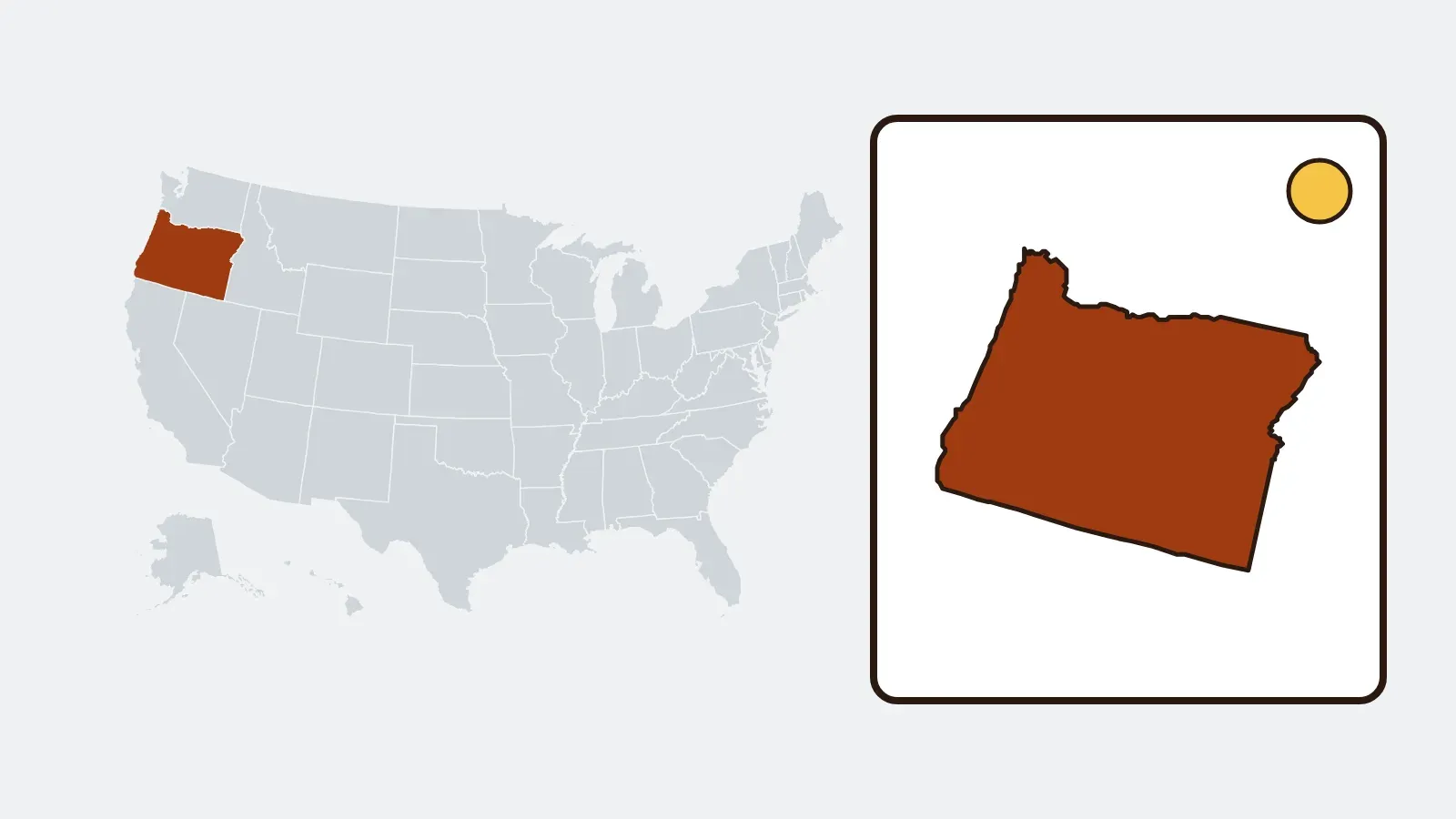
Oregon car-finance rules at a glance
- Right to cure
- None in state law; repossession may follow a default under the contract
- Rate ceiling
- No general cap on dealer contracts; finance charge as agreed
- ORS 83.560. Late charges are capped at 5% of the installment. Banks and credit unions follow their own rules.
- Doc fee limit
- $250 with an electronic integrator, $200 without (ORS 822.043)
- Fixed amounts in the 2025 edition of the statute; not indexed.
- After repossession
- Notice before sale; right to redeem; deficiency allowed
- Vehicle sales tax
- No sales tax; 0.5% privilege tax on dealer sales of new and low-mileage cars
- Applies to vehicles driven 7,500 miles or less; a trade-in does not reduce the taxable price.
- Regulator
- Oregon Division of Financial Regulation (DCBS)
What an Oregon dealer contract may charge
Oregon regulates the retail installment contract you sign at a dealership in ORS 83.510 to 83.680. The law sets the paperwork rules, but it does not cap the rate. Under ORS 83.560, the finance charge is whatever you and the dealer agree on. That makes the APR on the contract the number to shop, and a quote from a bank or credit union the yardstick to hold it against.
- Late charges. A delinquency charge may not exceed 5% of the late installment (ORS 83.590).
- Extensions. If the holder agrees to defer payments, it may charge a service fee of no more than $15 plus interest for the added months at no more than the contract rate (ORS 83.630).
- Acceleration. The holder may not demand the full balance arbitrarily when you are not in default, though moving the car out of state or selling it can still trigger acceleration (ORS 83.660).
Because no ceiling protects you, run any offer through the car payment calculator and compare total interest, not just the monthly payment.
Doc fees and taxes on an Oregon purchase
| Dealer setup | Maximum fee |
|---|---|
| Uses an integrator (electronic title and registration) | $250, of which $35 goes to the integrator |
| Does not use an integrator | $200 |
The fee is negotiable up to those limits. If a dealer charges more because it uses an integrator, it must tell you that the option exists so you can decide whether to use it. DMV rules require dealers to refund any overcharge within five business days of discovering it.
Oregon has no general sales tax. Instead, the vehicle privilege tax is 0.5% of the retail price of a taxable vehicle bought from a dealer: one driven 7,500 miles or less, with a gross vehicle weight rating of 26,000 pounds or less, and not titled in Oregon before. A trade-in or cash down payment does not reduce the taxable price, while items such as warranties, GAP coverage and the document fee are left out of it. A use tax at the same rate covers taxable vehicles Oregon residents buy from dealers elsewhere.
Missed payments and repossession in Oregon
Oregon gives car buyers no statutory notice-and-cure period before repossession. Your contract decides when you are in default. After that, the lender may repossess under Oregon's Article 9 rules, which moved from ORS chapter 79 to chapter 79A in 2025. Contract terms that would allow unlawful entry or a breach of the peace during repossession are unenforceable (ORS 83.670).
- Repossession. ORS 79A.6090 lets a secured party take the car after default, subject to the limits above.
- Notice before sale. The lender must send you a notification before it disposes of the car, with consumer-specific content (ORS 79A.6110 and 79A.6140).
- Redemption. You may redeem the car before it is sold by paying what the law requires (ORS 79A.6230).
- Deficiency or surplus. The sale proceeds go to the debt; you may owe a shortfall or be owed a surplus, and you can ask for an explanation of the math (ORS 79A.6150 and 79A.6160).
If you see trouble coming, read what to do when you fall behind and our guide to repossession.
Where to check a lender and complain
Oregon's Division of Financial Regulation, part of the Department of Consumer and Business Services, licenses non-bank lenders such as consumer finance companies. Oregon DMV licenses and inspects dealers. Banks and credit unions answer to their own regulators.
Division of Financial Regulation
Licenses consumer finance and other non-bank lenders and takes complaints about them through an online form.
Oregon Department of Justice
Handles consumer complaints about unfair or deceptive dealer practices.
Consumer Financial Protection Bureau
Takes complaints about any auto lender or loan servicer, including banks and finance companies.
Questions people ask
Is there a maximum interest rate on car loans in Oregon?
Not for dealer-arranged retail installment contracts. Oregon law lets the dealer and buyer agree on the finance charge, so compare the APR with offers from banks and credit unions.
How much can an Oregon dealer charge for a doc fee?
Up to $250 if the dealer uses an integrator for electronic title and registration, or up to $200 if it does not. The fee is negotiable within those limits.
Do I pay sales tax on a car in Oregon?
No sales tax, but a 0.5% vehicle privilege tax applies to new and nearly new vehicles bought from dealers. A trade-in does not reduce it.
Will I get a warning before my car is repossessed in Oregon?
State law does not require one. The lender must avoid a breach of the peace and must notify you before it sells the car.
Sources
- Oregon Revised Statutes, chapter 83: Motor vehicle retail installment contracts (2025 edition)
- Oregon Revised Statutes, ORS 822.043: Dealer document processing fees (2025 edition)
- Oregon Revised Statutes, chapter 79A: Secured transactions (2025 edition)
- Oregon Department of Revenue: Vehicle privilege and use taxes
- Oregon Division of Financial Regulation: Non-depository licensing
- Oregon Administrative Rules, OAR 735-150-0055: Dealer document-processing fee (via Cornell LII)
Facts on this page were checked against these sources on October 26, 2026. The statutes cited are from the 2025 edition of the Oregon Revised Statutes.
Read next
-
Guide
Retail installment contract
The disclosure box, the Holder Rule notice, spot delivery and arbitration clauses, and a signing checklist.
-
Guide
Out-the-door price
Every line from vehicle price to amount financed: doc fees, sales tax, add-ons and the trade-in.
-
Help
Repossession
When the lender can take the car, what an agent may not do, and how to get it back.