Indiana Car Loan Laws
Indiana caps finance charges under its consumer credit code, sets an inflation-adjusted ceiling on dealer doc fees, and gives no warning period before repossession.
Updated By Lenditia Editorial Team 6-minute read No right to cure
In short
Indiana's Uniform Consumer Credit Code caps the finance charge on a dealer credit sale at the greater of a tiered rate or 25% a year, so 25% is the working limit on most car contracts. Dealers may charge a document preparation fee of up to $261.72 as of July 1, 2026, and it has to be in the advertised price. Sales tax is 7%, and a trade-in reduces it only in a like-kind exchange. There is no right to cure before repossession, but on a credit sale with a cash price of $5,200 or less the seller cannot collect a deficiency. The Department of Financial Institutions administers the credit code.
- Right to cure
- None in state law
- Rate ceiling
- 25% a year on most loans
- Doc fee limit
- $261.72 (July 2026)
- Vehicle sales tax
- 7%
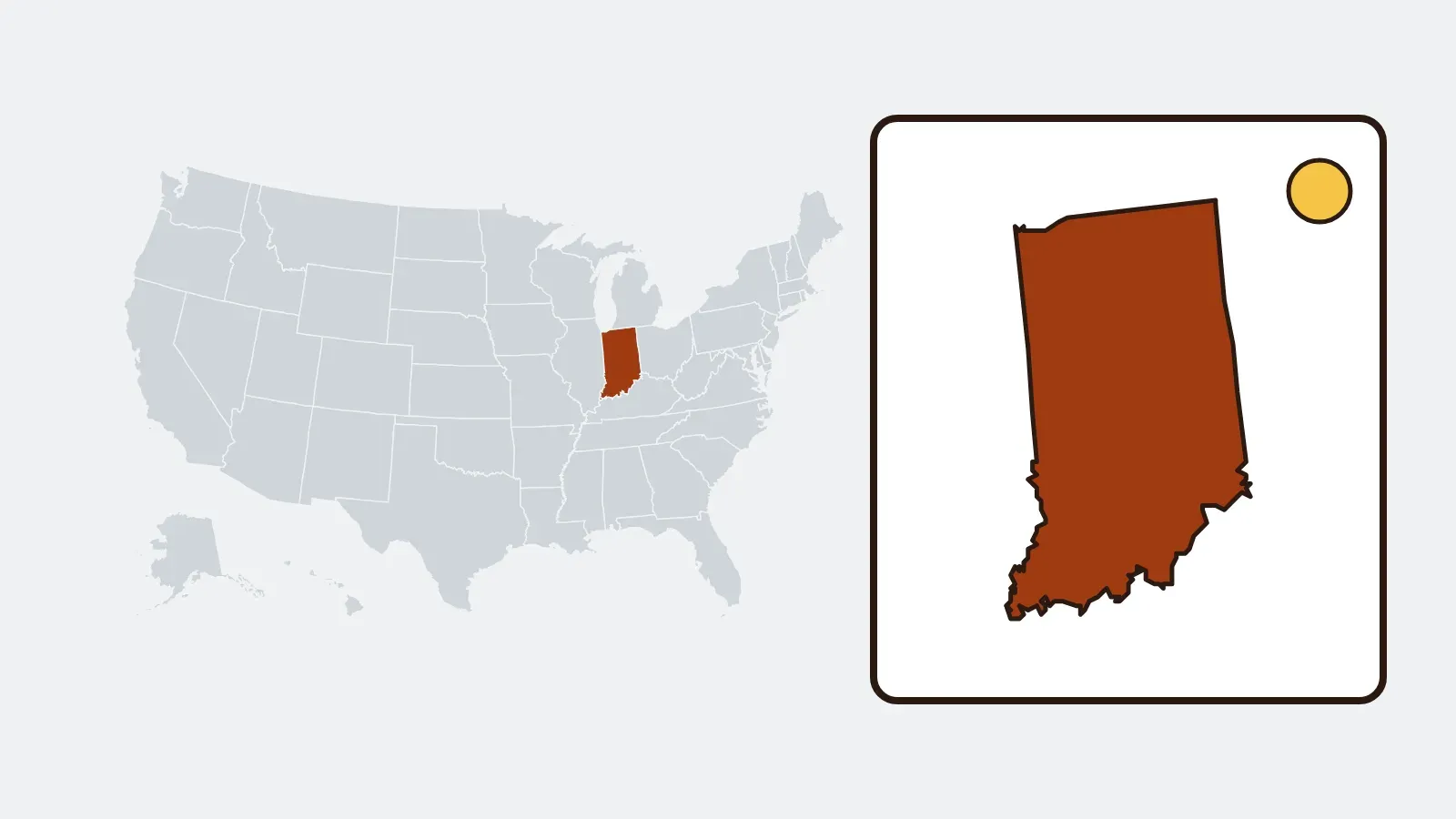
Indiana car-finance rules at a glance
- Right to cure
- None; repossession may follow a default without notice
- Indiana's version of the consumer credit code has no notice-of-cure section.
- Rate ceiling
- Greater of 36%/21%/15% tiers or 25% a year; 25% on most car balances
- IC 24-4.5-2-201; tiers adjusted to $2,600 and $5,200 from 2025. Banks and credit unions follow their own rules.
- Doc fee limit
- $261.72 from July 1, 2026; CPI-indexed; must be in the advertised price
- After repossession
- Notice before sale; you may redeem; no deficiency if cash price was $5,200 or less
- Vehicle sales tax
- 7%; trade-in deducted only in a like-kind exchange
- Regulator
- Department of Financial Institutions (DFI)
How much an Indiana car contract may charge
A retail installment contract signed at an Indiana dealer is a consumer credit sale under IC 24-4.5. Section 2-201 limits the finance charge to the greater of two amounts: a tiered rate, or 25% a year on the unpaid balance.
| Part of the amount financed | Tiered rate | Alternative |
|---|---|---|
| Up to $2,600 | 36% a year | 25% a year on the whole balance |
| $2,600 to $5,200 | 21% a year | 25% a year on the whole balance |
| Above $5,200 | 15% a year | 25% a year on the whole balance |
The dollar tiers are adjusted for inflation by the Department of Financial Institutions; the statute's original figures were $2,000 and $4,000. On a typical car balance, the tiered formula yields less than 25%, so the 25% alternative is the ceiling that matters. Banks and credit unions follow their own rules.
The gap between the ceiling and an ordinary rate is large. On $20,000 over 60 months, a 25% APR means a payment of $587.03 and about $15,222 in interest. At 8% APR, the payment is $405.53 and the interest about $4,332. Compare any offer with the car payment calculator, and bring a preapproval from a bank or credit union so you have a second number to test the dealer's offer against.
Doc fees and sales tax in Indiana
- Document preparation fee. IC 9-32-13-7 caps it and adjusts the cap for inflation. The Secretary of State's Auto Dealer Services Division will not take enforcement action on fees at or below $261.72 as of July 1, 2026.
- Disclosure. The fee must be included in the advertised price, disclosed to you in writing during the sale, and shown as its own line on the bill of sale.
- Sales tax. Indiana charges 7%. The Department of Revenue treats documentation fees as taxable; separately stated convenience fees are not.
- Trade-in. The trade-in deduction applies only to like-kind exchanges, such as a car traded toward a car, under the Department of Revenue's May 2026 bulletin on vehicle sales.
Falling behind and repossession in Indiana
Indiana's credit code has no section that requires a notice and a period to catch up before the lender acts. After a default, the rules come from Indiana's Article 9 of the Uniform Commercial Code, IC 26-1-9.1, plus one important limit in the credit code.
- Repossession. The lender may take the car without a court order if it avoids a breach of the peace (IC 26-1-9.1-609).
- Notice before sale. The lender must notify you before it disposes of the car (IC 26-1-9.1-611 to 9.1-614).
- Redemption. Until the sale, you can redeem the car by paying the secured debt plus reasonable expenses (IC 26-1-9.1-623).
- Deficiency. In a consumer credit sale where the cash price was $5,200 or less, the seller cannot hold you liable for the unpaid balance after it repossesses (IC 24-4.5-5-103, as adjusted). Above that, you may owe the shortfall.
Our guides to repossession and the deficiency balance walk through each step.
Where to check a lender and complain
The Department of Financial Institutions administers the consumer credit code and licenses consumer credit businesses. Dealers are licensed by the Secretary of State's Auto Dealer Services Division, which also publishes the doc fee figure. If a doc fee is above the current figure or missing from the bill of sale, raise it with the dealer in writing first, keep a copy, and then contact the Auto Dealer Services Division if the dealer does not fix it.
Department of Financial Institutions
Administers the consumer credit code, licenses consumer credit businesses and takes complaints on its form.
Auto Dealer Services Division
Part of the Secretary of State's office; licenses dealers and sets out the yearly doc fee figure.
Consumer Financial Protection Bureau
Accepts complaints about any auto lender or servicer nationwide.
Questions people ask
What is the maximum interest rate on a car loan in Indiana?
For a dealer credit sale, the greater of a tiered rate or 25% a year. On most car balances, 25% a year is the effective ceiling.
How much can an Indiana dealer charge for a doc fee?
As of July 1, 2026, the Secretary of State will not take enforcement action on fees at or below $261.72. The fee must be in the advertised price and listed on the bill of sale.
Does a trade-in reduce sales tax in Indiana?
Only in a like-kind exchange, for example trading a car toward another car. The 7% tax then applies to the price minus the trade-in.
Can I owe money after a repossession in Indiana?
Not on a consumer credit sale with a cash price of $5,200 or less. On larger purchases you can owe a deficiency. See what to do when you are behind.
Sources
- Indiana Code (2025), IC 24-4.5-2-201: Credit service charge for consumer credit sales
- Indiana Code (2025), IC 24-4.5-5-103: Restrictions on deficiency judgments
- 750 IAC 1-1-1: Adjusted dollar amounts in the consumer credit code (from January 1, 2025)
- Indiana Secretary of State, Auto Dealer Services: Doc fees in 2026
- Indiana Department of Revenue: Sales Tax Information Bulletin #28S, motor vehicles (May 2026)
- Indiana Code (2025), IC 26-1-9.1: Secured transactions
Facts on this page were checked against these sources on October 26, 2026. The doc fee figure of $261.72 applies from July 1, 2026.
Read next
-
Guide
Retail installment contract
The disclosure box, the Holder Rule notice, spot delivery and arbitration clauses, and a signing checklist.
-
Help
Deficiency balance
How lenders compute what you owe after a repossession sale, and how to check or dispute it.
-
Guide
Out-the-door price
Every line from vehicle price to amount financed: doc fees, sales tax, add-ons and the trade-in.